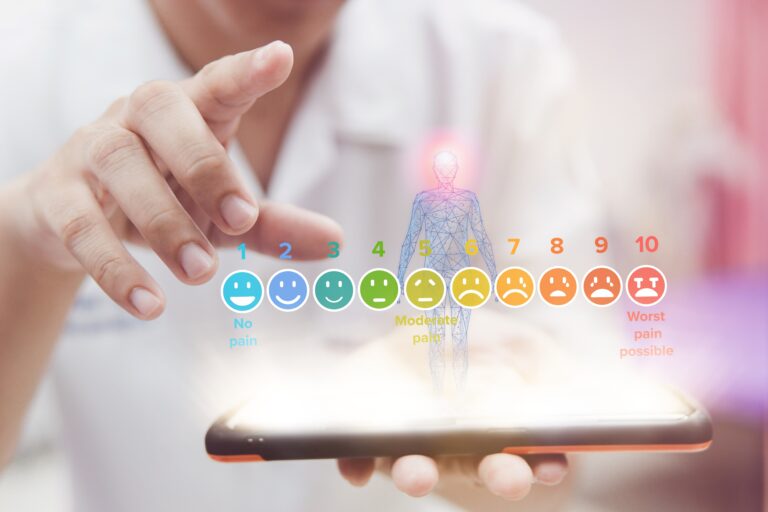
Pain Management: A Guide for Healthcare Providers

Pain management means helping people find relief and improve their quality of life. It focuses on treating the source of pain—not just the symptoms.

Pain is a strange thing. It can be sharp, dull, persistent—or even silent until the lights go out.
It’s personal.
It’s complex.
And it doesn’t always follow the rules.

If you’re a healthcare provider, you know how hard it is to treat pain. This guide gives you practical ways to assess and manage it—beyond just writing a prescription.

What Is Pain?

Sharp pain locate at the knee
Photo by frantic00 on Shutterstock

Pain is more than a physical feeling.
It’s a full-body, full-mind experience.

✅Physical
✅Emotional
✅Psychological
✅Social

You can’t separate pain from the person who feels it.
That’s why patient-centered care matters.

Global health systems are shifting toward more compassionate pain treatment.
Indonesia supports this through:

  1. Permenkes No. 11 of 2017 – Patient safety

  2. Permenkes No. 5 of 2014 – Clinical practice guidelines (PNPK)

The goal: Treat pain with empathy, skill, and context.

Regulatory Framework in Indonesia in Pain Management

Effective pain management in Indonesia is shaped by several national policies:

Firstly, Permenkes No. 11/2017 on Patient Safety recognizes pain control as a basic patient right and a key safety goal.

Secondly, Permenkes No. 5/2014 on PNPK promotes the use of clinical guidelines to ensure consistent pain assessment and treatment.

Thirdly, the Standar Akreditasi Rumah Sakit (SNARS) requires regular pain assessments in nursing and medical documentation.

These policies reinforce the ethical duty to manage pain fairly and effectively in all healthcare settings.

What Sharp Pain Tells You

It’s sudden, intense, and hard to ignore.
But listen closely.

Some patients say it shoots down their leg.
Others feel like something’s cutting them inside.
Same word, different stories.

Why Nerve Pain Feels Worse at Night

Patients often say, “It gets worse at night.”
They’re right.

Here’s why it might happen:

  1.  Less distraction makes pain more noticeable.
  2. Cortisol levels drop at night (less anti-inflammatory effect).
  3. Circadian rhythm may increase sensitivity.

This doesn’t mean it’s harder to treat.
It means you need to adjust timing and expectations.

Sometimes the simplest methods are overlooked:

When a patient says their pain is sharp, think acute.
It often means tissue damage, nerve irritation, or post-surgical pain.

Pain Management Tools: Makes Pain Visible

Pain can’t be seen, but it can be measured.
Use the right tool for the right patient. Here are some of widely used tools in measuring pain.

🔹 Numerical Rating Scale (NRS)

Rates the pain from 0–10.

🔹 Visual Analog Scale (VAS)

Marks intensity on a line as stated by the patient.

🔹 Wong-Baker FACES

Used for kids or non-verbal patients.

🔹 McGill Pain Questionnaire

Explores the quality and impact of pain.

🔹 Brief Pain Inventory (BPI)

Links pain to function.

Numbers don’t tell the whole story.
A “7” for one patient might mean something very different for another.

When to Assess Pain

Pain should be assessed:

Firstly, during admission.

Secondly, after any procedures

Thirdly, pain assessment has to be done regularly during care.

And lastly, before and after pain interventions.

Assessing pain
Photo by zackKOP on Shutterstock

Document everything.
Reassess often.
That’s how you track progress and ensure continuity of care.

Managing Pain: More Than Medication

Pharmacological Therapies

Use what works—but carefully.

  1. Start with acetaminophen or NSAIDs.
  2. Use opioids with caution and review regularly.
  3. Add antidepressants or anticonvulsants for nerve pain.

Prescribing is just step one.
You also need to monitor and adjust.

Multimodal and Multidisciplinary Management

Effective pain care doesn’t rely on just one method.
It combines several strategies:

  1. Pharmacologic: Follow WHO’s stepwise pain ladder
  2. Non-pharmacologic: Use physiotherapy, CBT, heat/cold therapy, relaxation, or acupuncture
  3. Patient involvement: Teach and empower patients to manage their own pain

Non-Drug Approaches

Often overlooked. But effective.

  1. Physical therapy – Gentle movement helps
  2. CBT (Cognitive Behavioral Therapy) – Changes how patients respond to pain
  3. TENS (Transcutaneous Electrical Nerve Stimulation)  – Offers relief through nerve stimulation
  4. Heat, cold, massage, mindfulness – Simple but effective

Use them together.
Pain is layered.
So is treatment.

Alternative Methods That Help

Some patients ask about essential oils.
They’re not a cure, but they can support comfort.

  1. Eucalyptus, peppermint, lavender – May help joint discomfort
  2. Lavender or rosemary aromatherapy – Can reduce stress in chronic pain

Always combine with medical care.
Comfort can make patients more consistent with treatment.

What Can you Do Next?

✅ Ask clear questions

✅ Listen for patterns

✅ Track pain over time

✅ Mix treatment methods

✅Stay informed


Pain isn’t just a symptom.
It’s part of your patient’s daily life.

Your role?
Help make that life more livable.

📘 Want to deepen your skills in clinical pain management?


Join our Pain Management Course today!  Expand your tools, improve outcomes, and offer care that feels both effective and human.

References
    1. Cavanagh, T., Chen, B., Lahcen, R. A. M., & Paradiso, J. (2020). Constructing a Design Framework and Pedagogical Approach for Adaptive Learning in Higher Education: A Practitioner’s Perspective. The International Review of Research in Open and Distributed Learning, 21(1), 172–196. https://doi.org/10.19173/irrodl.v21i1.4557

    2. Gligorea, I., Cioca, M., Oancea, R., Gorski, A.-T., Gorski, H., & Tudorache, P. (2023). Adaptive Learning Using Artificial Intelligence in e-Learning: A Literature Review. Education Sciences, 13(12), 1216. https://doi.org/10.3390/educsci13121216

    3. Hinkle, J. F., Jones, C. A., & Saccomano, S. (2020). Pilot of an Adaptive Learning Platform in a Graduate Nursing Education Pathophysiology Course. Journal of Nursing Education, 59(6), 327–330. https://doi.org/10.3928/01484834-20200520-05
    4. Kumar, P. (2023). Transformative Role of ICT in 21st Century Learning: Enhancing Educational Effectiveness and Equitability. International Journal for Research in Applied Science and Engineering Technology, 11(12), 91–95. https://doi.org/10.22214/ijraset.2023.57028 

    5. Meyers, R. (2024, October 15). 12 Benefits Of Adaptive Learning Architecture. ELearning Industry. https://elearningindustry.com/benefits-of-adaptive-learning-architecture

    6. Plooy, E. du, Daleen Casteleijn, & Franzsen, D. (2024). Personalized adaptive learning in higher education: a scoping review of key characteristics and impact on academic performance and engagement. Heliyon, e39630–e39630. https://doi.org/10.1016/j.heliyon.2024.e39630
    7. Pusic, M., Hall, E., Billings, H., Branzetti, J., Hopson, L. R., Regan, L., Gisondi, M. A., & Cutrer, W. B. (2022). Educating for adaptive expertise: case examples along the medical education continuum. Advances in Health Sciences Education, 27(5), 1383–1400. https://doi.org/10.1007/s10459-022-10165-z
    8. Rincon-Flores, E. G., Castano, L., Lissette, S., Omar Olmos Lopez, Felipe, C., Angélica, L., & Patricia, L. (2024). Improving the learning-teaching process through adaptive learning strategy. Smart Learning Environments, 11(1). https://doi.org/10.1186/s40561-024-00314-9